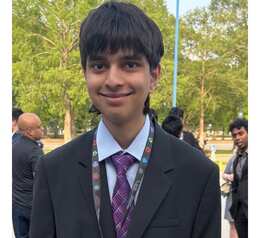
Anhad Kashyap
Vasant Valley School, India
Title: Refracted Realism: The Power of Perspective
Biography
Anhad Kashyap is an innovator and social entrepreneur from India. Gifted in STEM, his strong junior-school performance masked underlying issues. Almost overwhelmed by anxiety, his neurodiversity diagnosis in high school included ADHD, dysgraphia and Social Communication Disorder.
That experience made him acutely aware of the need for inclusive, human-centered design, propelling him to address gaps in healthcare access, education and public infrastructure for underprivileged communities. His innovations reflect technical depth, compassion and grassroots understanding of need:
- SentiMeter.AI: an AI-powered anti-bullying and sentiment analysis device
- DysCover Arcade: a gamified early dysgraphia detection tool
- ExFire Brick: a reusable, maintenance-free autonomous fire suppression system
Alongside recognition in international STEM competitions, he has published technical research and is a NYAS Junior Academy member. Anhad’s bilingual science-fiction book, Vox TechnoratEYE, launched at the Dehradun Literature Festival and was featured in Hyderabad and Delhi. He is also a concert pianist and violinist.
Abstract
Objective:
This oral presentation will introduce Refracted Realism, the proposition that perception is shaped by individual lived experience, as white light is refracted through a prism and tests it as a design methodology rather than a metaphor. It establishes how centering neurodivergent lived experience at the design stage yields measurably more inclusive technology.
Scope:
Until grade 9, I was the “gifted kid with quirks”: excellent grades, competitive STEM wins, and an unseen substrate of anxiety and executive dysfunction. A late diagnosis of ADHD, dysgraphia and Social Communication Disorder reframed the problem. I had been trying to fit systems never built for minds like mine. The work that followed spans three domains where systems fail the populations they nominally serve: peer-bullying reporting, learning-disorder (dysgraphia) screening, and fire safety in informal settlements, developed and deployed in New Delhi, India.
Methods:
SentiMeter.AI applies natural language processing to anonymous bullying reports, detecting paralinguistic distress markers (hesitation, tremor, emotional pattern) and escalating cases that self-report as minor. DysCover Arcade uses three gamified tasks with computer-vision and deep-learning models, trained on behavioural, eye-tracking and neuroimaging data, to pre-screen for dysgraphia. ExFire Brick embeds biomimicry-inspired suppressant chambers within standard construction units, requiring no electricity, plumbing or maintenance.
Results:
SentiMeter.AI is deployed across three New Delhi NGOs, reaching 200+ children; aggregated data surfaced institutional patterns that partners then addressed through training. DysCover Arcade achieves 92% classification accuracy, removing the specialist-waitlist barrier to early identification. ExFire Brick converts existing housing into passive fire defense where emergency services do not arrive.
Conclusion:
Designing from the margin generalizes. Built for the most constrained users, each solution proved adaptable to the widest range. Proving conclusively that evidence that neurodivergence is not a deficit to be remediated but an underused source of design insight.
 22-23 Mar 2027
  Paris, France